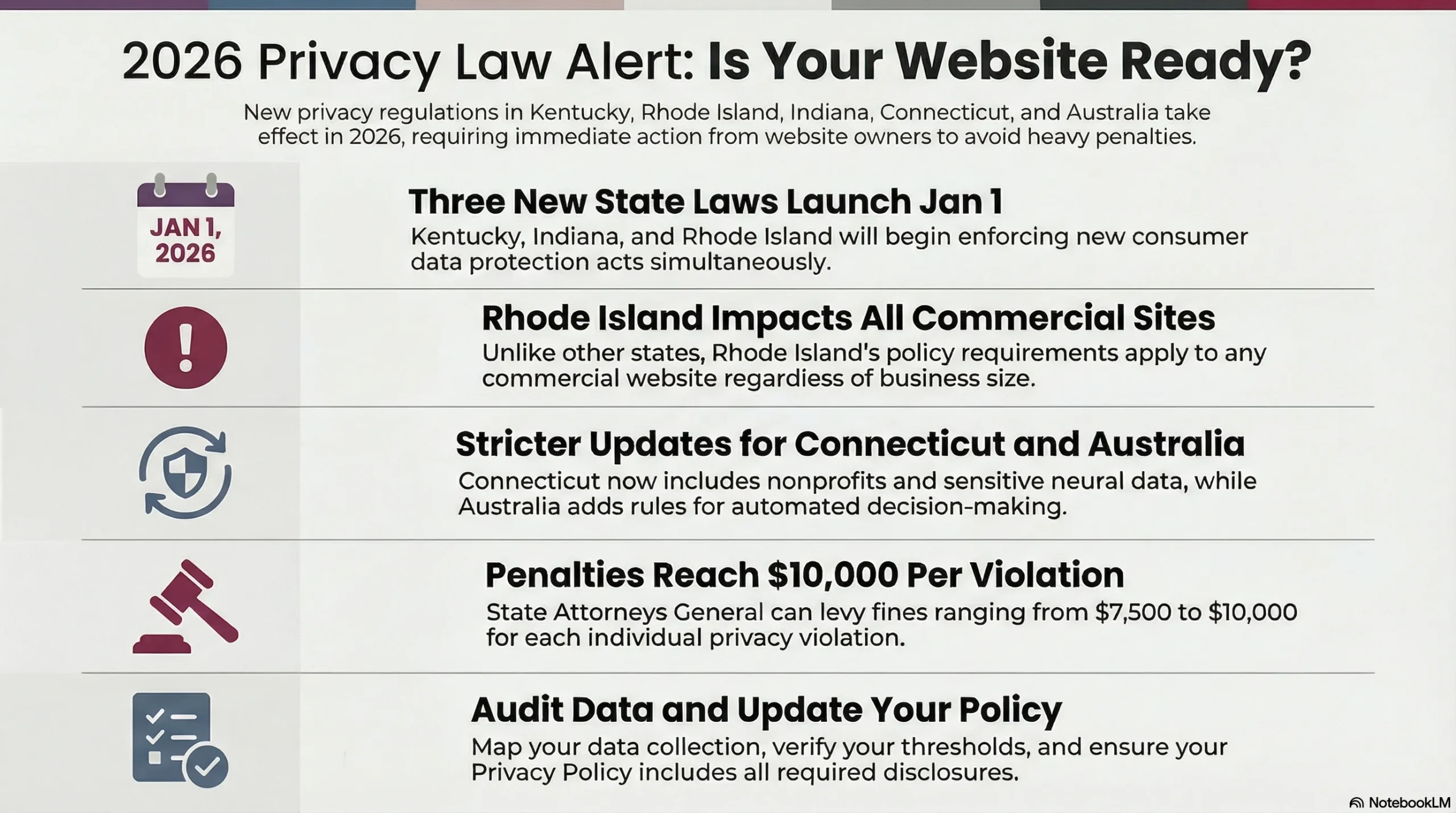

Big changes just landed for how businesses use AI. This week, new rules in the United States and in Europe started asking companies to be honest about the AI tools they use. If you own a small business, that might sound scary.
But here's the good news. Almost every one of these new rules comes down to one simple idea. Be honest. Tell people when a robot helper is answering them. Tell people when AI helped make your words or pictures. And keep a few simple notes about the tools you use. That's most of it. You can do this, and you don't have to do it alone.
Key Takeaways
- The rules are here. New AI rules started on August 2, 2026, in both the United States and Europe.
- It's mostly about honesty. Almost every rule asks for one thing, be open about how you use AI.
- Tell people. Let them know when a chatbot is answering them, or when AI helped make your content.
- Keep a list. Write down the AI tools you use and what you use them for.
- Check your insurance. Ask your agent if your policy covers problems that come from AI.
- Trust is the goal. Honesty is simply how you build it.
What's Going On With AI Right Now?
AI has grown fast. Tools like chatbots and writing helpers are everywhere now. They save time. They help small businesses do big things. (I use them too, and I love what they can do.) But when something grows this fast, the rules usually catch up later. That's what's happening now.
On August 2, 2026, new rules started in two big places at the same time. The United States and Europe. These rules are about AI. They don't try to stop you from using it. They ask you to be open and honest about it.
Let me explain a few of these changes in plain words.
First, there are new "tell people" rules. If a customer is chatting with a robot instead of a real person, you may need to say so. If you use AI to make a picture or write a post, some rules ask you to mark it. The idea is simple. People deserve to know what is real and what a machine made.
Second, a big court case just ended. A large AI company had to pay a lot of money, more than a billion dollars, because it used people's books to build its AI without asking first. That is a huge number. The lesson for the rest of us is clear. AI is not a free-for-all. The words, pictures, and music that go into these tools belong to real people. The rules are catching up to protect them.
Third, some insurance companies are changing their rules too. A few are adding lines to their policies that say they will not pay for problems caused by AI. That is worth knowing before your next renewal.
I know that's a lot. Take a breath. None of it means you should stop using AI. It just means the world is asking businesses to be more careful and more honest. And honesty has always been good for business.
Why Should a Small Business Owner Care?
You might be thinking, "These rules are for the big tech companies, not for me." I understand why it feels that way. But here's the thing. Even when a rule doesn't point straight at your business, it often points at the tools you use every day.
Think about it like this. You may not run a giant AI company. But you might use a chatbot on your website. You might use AI to help write a newsletter. You might use it to make a graphic for social media. The rules for those tools can reach you through the back door.
There's also a bigger reason to care, and it has nothing to do with fear. It's about trust. Your customers are smart. Many of them already wonder if the email they got was written by a person or a machine. When you're open about how you use AI, you show them respect. You show them you have nothing to hide. And trust, as you already know, is the thing that turns a first-time customer into a loyal one.
So this isn't just about following rules. It's about being the kind of business people feel safe choosing.
The One Idea Behind Almost Every New Rule
Here's the part I really want you to hear. If you step back and look at all these new rules together, they're all saying the same thing. It's just three words.
Show your work. Be able to show what your AI tools do. Show people when AI is involved. And show honest records if anyone ever asks.
Businesses that can do this will have an easier time everywhere, with customers, with courts, and with insurance. Businesses that can't will have a harder time. Not because they did something bad, but because they can't answer simple questions. "Did AI write this?" "What does your chatbot do with the words I type in?" "Can you prove it?" If you can answer those questions plainly, you're in a strong spot.
The good news is that showing your work is not hard. It just takes a little care. Let me give you three simple steps.
Three Simple Steps You Can Take Right Now
You don't need a lawyer or a tech degree to start. Here are three small things that make a big difference.
Your Three-Step AI Trust Checklist
- Tell people when AI is helping. If a chatbot answers questions on your website, add a short line so people know it's a bot. If AI helped you make an image, you can note that too. One honest sentence is enough. Being upfront builds trust and keeps you on the right side of the new rules.
- Keep a simple list of your AI tools. Grab a notebook or open a plain document. Write down the AI tools you use, and next to each one, write what you use it for. (Really, that's the whole thing.) If a customer or a rule ever asks how you use AI, your answer is already ready.
- Ask your insurance agent one question. Before your next renewal, call the person who handles your business insurance and ask, "Does my policy cover problems that come from using AI?" Some policies now leave AI out. It's better to know now than to find out later.
Three steps. That's a strong start. You don't have to do it all at once. Pick one this week and go from there.
You Don't Have to Figure This Out Alone
Here's what I don't want. I don't want you to read all of this, feel worried, and then freeze. That helps no one.
New rules can feel like one more thing on a list that's already too long. I get it. You started your business to do the work you love, not to become an expert on AI law. (Same here, friend.) That's exactly why partners exist.
At TBS, keeping up with changes like these is part of my job, so it doesn't have to be all of yours. When I help a client use AI in their marketing, I build in the honest, simple habits that keep them safe and trusted. Little things, done right, from the start. That way you get the time-saving power of AI without the worry.
You can grow your business and use these new tools with confidence. You just want to do it the honest way. And honestly? You were probably going to do that anyway.
Frequently Asked Questions
Do these new AI rules apply to my small business?
Maybe. And even when they don't apply straight to you, they often apply to the tools you use. The safe move is simple. Be open about how you use AI. That keeps you in good shape no matter what.
Do I really have to tell people when I use AI?
In more and more cases, yes, especially with chatbots and AI-made content. But even when it isn't required, being honest is smart. It builds trust, and trust is good for business.
What's the easiest first step?
Start a simple list of the AI tools you use and what you use them for. It takes a few minutes, and it puts you ahead of most small businesses.
Should I stop using AI just to be safe?
No. AI is a wonderful helper when you use it with care. The new rules aren't about stopping. They're about being honest and keeping simple records.
What if I don't understand all of this?
That's normal, and it's okay. You don't have to understand every rule. You just need a partner who does. That's exactly what I'm here for.
Final Thoughts
Big words and legal news can make AI feel scary. But when you strip it all down, the message is gentle and kind. Be honest. Tell people when a machine is helping. Keep a few simple notes. That's the heart of almost every new rule, and it's also just a good way to run a business.
You've built something real. You care about doing right by the people you serve. These new rules are simply the world catching up to a truth you already live by. Honesty builds trust, and trust builds a business that lasts.
Want help using AI in your marketing the honest, worry-free way? That's exactly what I do. Let's talk.
Let's Talk → Schedule a Free Consultation