
It feels like just yesterday we were all trying to wrap our heads around the regulations that launched in 2025. Now, here we are looking toward 2026, and a fresh wave of privacy law changes is heading straight for small business websites.
I have seen so many business owners feel overwhelmed by how quickly technology and legal requirements shift. It is completely normal to feel like you are chasing a moving target when you are already busy running a business or a mission driven nonprofit. While these changes might seem like a burden, I want to encourage you to see them as a bridge to your community. Let's walk through what is coming so you can move forward with clarity and peace of mind.
Key Takeaways
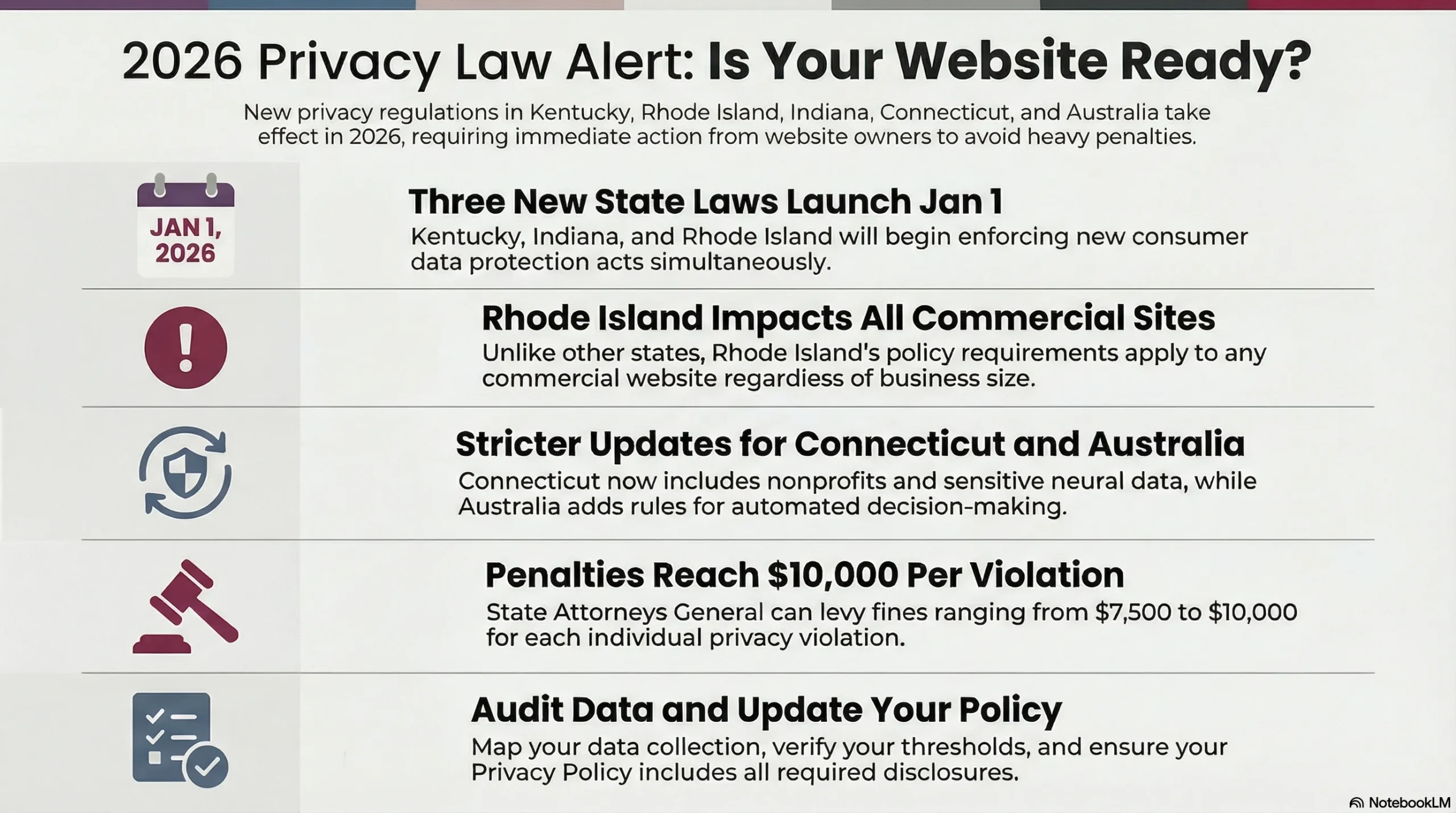
- Three new states join the list. Kentucky, Rhode Island, and Indiana will launch comprehensive privacy laws on January 1, 2026.
- Rhode Island's rule is different. Its DTPPA requires a Privacy Policy if you have even one customer or visitor from that state, no matter your size.
- Nonprofits are no longer exempt in Connecticut. The state is removing its nonprofit exemption and lowering its general compliance thresholds.
- AI transparency is now part of privacy law. Australia and Connecticut are expanding protections to cover AI decision making and neural data.
- Your location does not protect you. If you have customers in these areas, you are responsible for following their rules, regardless of where your office sits.
The One Resident Rule: Why Rhode Island Is a Game Changer
On January 1, 2026, the Rhode Island Data Transparency and Privacy Protection Act (DTPPA) will go into effect. This law is one that every small business owner should watch closely. Most state laws, such as those in Kentucky or Indiana, only apply to businesses that process the data of at least 100,000 residents. Rhode Island has a different standard.
While Rhode Island sets a threshold of 35,000 residents for specific consumer privacy rights, the requirement to have a Privacy Policy is much broader. This rule applies to any commercial website doing business with even one Rhode Island resident.
Because of this specific rule, a compliant Privacy Policy is now essentially mandatory for almost every e-commerce site in the country. If you sell a single digital product or physical item to someone in the Ocean State, you must be transparent about your data practices.
Worth noting: Legal experts have pointed out that Rhode Island's privacy law will affect businesses of every size, not just larger companies with dedicated compliance teams.
The End of the Nonprofit Pass
For a long time, many nonprofits felt they were in a safe harbor when it came to complex privacy regulations. However, the legal landscape is shifting to reflect the reality that mission driven organizations often handle very sensitive information. This can include donor records, health data, or even religious affiliations.
As of July 1, 2026, the Connecticut Data Privacy Act (CTDPA) is removing the exemption for nonprofits. Additionally, Connecticut is making it easier for the law to apply to smaller organizations. The threshold for compliance is dropping from 100,000 residents down to 35,000 residents.
They are also tightening the revenue rule. Previously, the law applied if you processed data for 25,000 residents and made 25% of your revenue from data sales. That revenue threshold is dropping to 20%. This is a major shift for nonprofits and small businesses that must now prioritize data transparency to stay compliant.
AI and Neural Data: The New Frontier of Personal Info
Technology often moves faster than our laws, but 2026 is the year where the legal system starts catching up to advanced tech. Australia and Connecticut are both leading the way by protecting very specific, high tech categories of information.
Automated Decisions Need to Be Disclosed
In December 2026, Australia will require businesses to be fully transparent if they use computer programs or AI to make significant decisions about people. If an algorithm is used to pre-screen a loan or make a decision that impacts someone's rights, your Privacy Policy must explain what data is being used.
Neural Data Joins the Sensitive Category
At the same time, Connecticut is adding neural data to its list of sensitive information. With the rise of advanced health tech and brain computer interfaces, lawmakers want to ensure this deeply personal biological data is protected. Being honest about automated decision making and sensitive biological data is becoming the new standard for business integrity.
Location Is Irrelevant: The Doing Business Reality
One of the biggest myths in the business world is that you only have to follow the laws of the state where your desk is located. If you operate online, your physical office location is actually secondary to where your customers live.
Consider this hypothetical scenario. If you run a small consulting firm in Ohio and a resident from Rhode Island fills out your contact form, you are now collecting data from a Rhode Island resident. This simple act could trigger the requirements of the Rhode Island DTPPA. Online visibility means you have a multi state responsibility. Simply doing business or targeting residents in these areas is the trigger for compliance, no matter where you happen to be sitting.
The Cost of Silence: Enforcement and Penalties
These laws are not just helpful suggestions for your website. They are enforced protections backed by State Attorneys General who are tasked with protecting their residents. Choosing to ignore these updates can lead to significant financial consequences.
Penalties at a Glance
- Rhode Island: Up to $10,000 per violation.
- Kentucky: Up to $7,500 per violation.
- Indiana: Up to $7,500 per violation, plus additional investigation costs.
Frequently Asked Questions
What counts as personal data?
Personal data is any information that can be linked to a specific person. This includes common items like names and email addresses. However, it also includes digital markers like IP addresses, cookie identifiers, location data, and device IDs.
Do I need to be located in Kentucky for their law to apply to me?
No. The law applies if you do business in Kentucky or target your services to people living there. Your physical location does not exempt you from their resident protection laws.
What are the main rights these laws give to consumers?
Most of these new laws give residents the right to access their data, delete it, or fix mistakes in the records you keep. They also allow consumers to opt out of the sale of their data or targeted advertising.
How can I tell if my business meets the threshold for compliance?
You should start by looking at your annual data. While Kentucky and Indiana generally look for 100,000 residents, remember that Rhode Island's Privacy Policy requirement starts with just one resident. If you have an e-commerce store, you likely meet at least one state's requirement.
What is the first step I should take to get ready for 2026?
The best first step is to perform a simple data audit. Map out what information your website collects through forms or analytics, how you use that info, and who you share it with. Having this clarity makes the rest of the process much easier.
Final Thoughts
While 2026 brings new regulations, it also brings a clear path forward for those who prepare early. By understanding these shifts today, you can make sure your website remains a professional and reliable space for your community.
Is your website a place where customers feel their data is respected, or is it a liability waiting to happen?
Let's simplify your marketing and your compliance together. Focus on what you do best, and let your online presence support you.
Let's Talk → Schedule a Free ConsultationThis post was created with the help of AI tools and reviewed by a member of the Targeted Business Support team before publishing. We believe in using technology wisely, and that means keeping a human heart and a careful eye on everything that goes out under our name.